

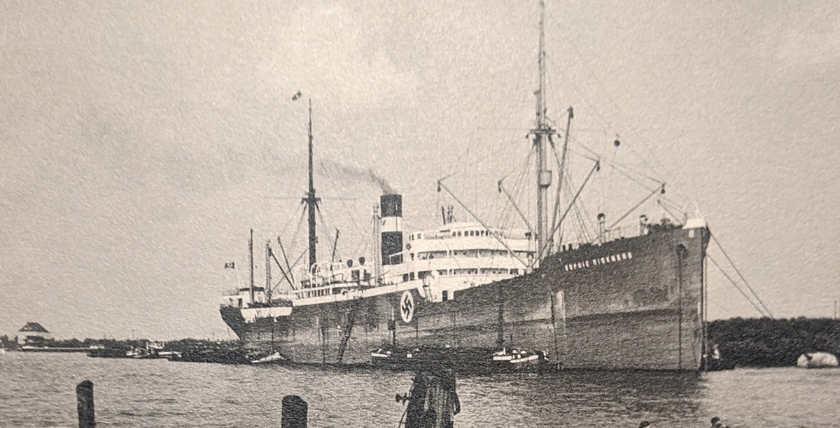


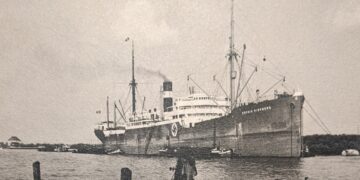
Countless German cargo ships were at the beginning of the Second World War II abroad, the way back to their homeland was denied them. In Indonesia, the crew of the Sophie Rickmers for better times.
Zahlreiche deutsche Handelsschiffe wurden nach der Besetzung der Niederlande durch die deutsche Wehrmacht 1940 von den niederländischen Behörden beschlagnahmt. Zu ihnen gehörte der 7033BRT-Frachter Sophie Rickmers. Bei seinem Stapellauf 1920 das größte Schiff der Rickmers-Reederei in Hamburg, war er auf dessen Sibirien-Linie und im Ostasienhandel eingesetzt, was ihm beim Ausbruch des Zweiten Weltkriegs zum Verhängnis werden sollte. Wochenlang von einem britischen Zerstörer verfolgt,[ds_preview] suchte der Frachter Ende 1939 in der Bucht Pria Laot der nördlich von Sumatra gelegenen Insel Pulau Weh Zuflucht und konnte dank des stürmischen Wetters seinem Verfolger entkommen. Lediglich einen harmlosen Treffer hatte Kommandant Helms zu beklagen, sodass man meinte, gerettet zu sein. Was die Besatzung nicht ahnte, war, dass ihr der tropische Unterschlupf bald zu einem zwar idyllischen, aber dauerhaften Gefängnis werden sollte. Denn kaum hatte man das Schiff wieder seetüchtig gekriegt und war klar zum Auslaufen, setzte der deutsche Einmarsch in den Niederlanden allen Hoffnungen auf eine Rückkehr nach Europa ein Ende. Pulau Weh gehörte zum holländischen Kolonialbesitz, und die Kolonialbehörden dachten nicht daran, angesichts des brachialen Vorgehens Hitlers in ihrer Heimat auf ihre unfreiwilligen deutschen Gäste große Rücksicht zu üben. Was die Männer der Sophie Rickmers in jener Zeit erlebten und wie sie sich letztlich der Beschlagnahme ihres Schiffes entzogen, haben zwei Überlebende vor einigen Jahren einem Journalisten berichtet (Daniel Furth, Das Schicksal der Sophie Rickmers: Gefangen in der Palmenbucht, DER SPIEGEL, 21.9.2012). Anbei eine Zusammenfassung der damaligen Ereignisse:
At first, things didn't actually look too bad for the crew of the Sophie Rickmers in their involuntary exile. Although they were in permanent quarantine after arriving in Pria Laot, the freighter was not the only German ship that had to wait out the events of the war in Pulau Weh. However, she was not allowed to leave her bay, while another steamer from her shipping company, the Moni Rickmers, was allowed to moor in Sabang harbour with three other German vessels. The reason for this was quite obvious. The Sophie's cargo consisted partly of explosives and therefore posed an incalculable risk to the island's population, especially in times of war. Nevertheless, the Dutch authorities initially left them in peace and even granted them an audience with the local raja, who warmly welcomed their German guests and entertained them royally. The crew were also able to refit the ship and go hunting or fishing in their ample free time under the guidance of local islanders.
The question remained as to when they would finally be allowed to weigh anchor and sail home. The naval command, to which the German merchant ships were formally subordinate in times of war, considered it advisable to remain in Pria Laot for the time being. But what could they do with all that time, many a crew member wondered. At some point, they had seen everything, made excursions into the interior, enjoyed Malay specialities and taken part in pretty much all the traditional festivals. The boredom that inevitably set in was not helped by the fact that some of the men on board the Sophie Rickmers took on girlfriends, a not entirely harmless pastime given the strict local customs. But the uncertain future increased the willingness to take risks. At least the raja's hospitality paid off when he offered Commander Helms and his men the chance to deposit their valuables in his palace in view of the looming events in Europe.
The offer came just in time. Because when the British radio announced the occupation of the Netherlands on 9 May 1940, the peaceful wintering in summery climes was over. The Sophie Rickmers was now in enemy territory and it was not possible to set sail due to the British warships patrolling the bay. As Helms justifiably feared that his ship would be confiscated by the local authorities, he finally ordered that precautions be taken to sink the ship himself. The following day, on 10 May, a Dutch launch did indeed appear, whose commander demanded that the freighter be handed over. Helms acted unsuspecting and entertained the uninvited visitor with cold drinks, but in the meantime ordered his men to open the sea valves. By the time the Dutch realised his intentions, it was already too late. All that was left for them to do was to be annoyed at their own credulity and watch the Sophie sink from a safe distance together with the Germans they had rescued.
The self-sinking had serious consequences for Helms and his crew. Like the crews of other German ships, they were taken to a jungle camp and treated as enemies. Some of the prisoners died of malaria and the others only returned home months after the end of the war. At least the Raja on Pulau Weh had kept his promise. When a ship from the Rickmers shipping company called at Pua Weh in the mid-1950s, it was able to take all of the Sophie Rickmers crew's belongings home with it.
The wreck of the Sophie is a popular destination for divers today. It lies at a depth of around 30-50 metres and is in relatively good condition despite the decades that have passed.
Andreas von Klewitz
Andreas von Klewitz studied Slavic Studies and Eastern and Southern European History and is a freelance journalist.




 English
  German
0 Kommentare