






The German Aerospace Centre (DLR in Cologne) and the German Federal Police (BPol) are working more closely together in the field of maritime security. The Chairwoman of the DLR Executive Board and the President of the Federal Police Headquarters (Potsdam) signed a cooperation agreement in Neustadt/Holstein on 21 November 2024.
The agreement deals with the joint testing and further development of capabilities for the protection of maritime critical infrastructures (KRITIS).
Für das DLR ist Sicherheit eines der Grundbedürfnisse der globalisierten Gesellschaft. Als Querschnittsthema bringt[ds_preview] die zivile Sicherheits- und Verteidigungsforschung des DLR alle Kompetenzen und Infrastrukturen aus Luft- und Raumfahrt sowie Verkehr und Energie zusammen. Die BPol sei einer der wichtigsten Kooperationspartner des DLR im Bereich der öffentlichen Behörden und Agenturen. Diese Zusammenarbeit ermögliche den gezielten Austausch und die konsequente Weitergabe von Wissen und Erfahrungen, sowie von Innovation und Technologien, so die Vorstandsvorsitzende.
The cooperation with DLR opens up new opportunities for the BPol to integrate modern technology and scientific expertise into the work of the Federal Police. This not only strengthens their operational capability, but is also an important step into the future. The partnership with DLR is a further building block for the security of our country, said the President.
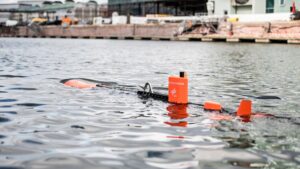
The sea cat at work in the harbour basin. Image: DLR (CC BY-NC-ND 3.0)
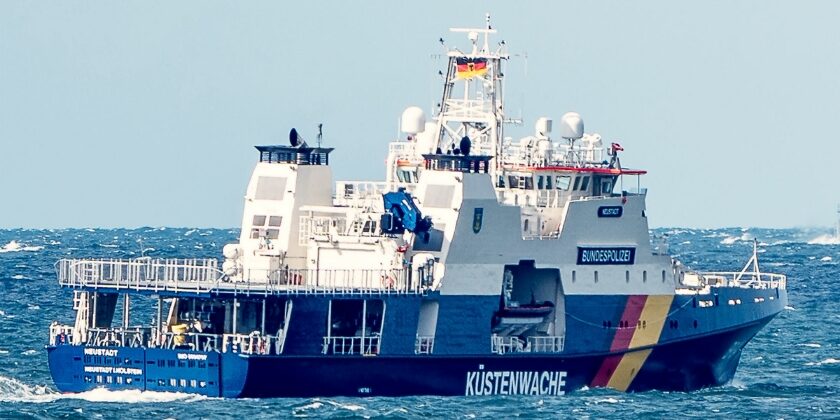
The cooperation agreement was signed on the "Neustadt" (Potsdam class, 86 metres), an operational vessel of the BPolSee. The "Neustadt" has only been in service since summer 2023. On the ship, DLR used videos and display boards to present the 3.50 metre-long Seekatze submersible, among other things. The autonomous underwater vehicle detects damage to pipelines and data cables at depths of up to 600 metres or tracks down lost cargo, for example. The DLR Institute for the Protection of Maritime Infrastructures in Bremerhaven is continuously developing the Seekatze's capabilities.
DLR also provided information about a remotely operated vehicle (ROV) that takes underwater images. The high-resolution image data from the ROV provides a precise view of the underwater situation in real time. In an earlier project, the sensor technology already captured information about sunken ships or munitions.
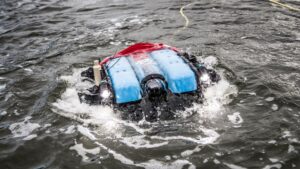
Autonomous diving robot in action. Image: DLR (CC BY-NC-ND 3.0)
Background information
DLR and BPol have been working together for around 15 years on topics that affect Germany's security - especially in the maritime sector. One example is the EMSec project (real-time services for maritime security), in which the parties involved combine satellite images, aerial photographs and ship signal reports to create up-to-date situational awareness information. In the HEDELA (Helicopter Deck Landing Assistance) project, DLR worked with BPol to research assistance systems to support helicopter pilots in landing safely and precisely on ships, and the MaRPAS3 (Maritime Remotely Piloted Aircraft System - Operation 3) project was about landing an unmanned aircraft on a ship's deck. In October 2024, BPol, the Federal Maritime and Hydrographic Agency (BSH) and DLR jointly conducted tests to defend against drones. The aim was to gain insights into increasing maritime safety.
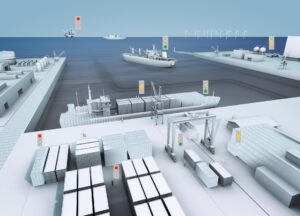
Vision image of a traffic light system at or in front of a harbour. Image: DLR (CC BY-NC-ND 3.0)
DLR is the German Aerospace Research and Technology Centre. In its core areas, it develops technologies for aeronautics, space, energy and transport as well as security and defence research.
The DLR Institute for the Protection of Maritime Infrastructures, based in Bremerhaven, was founded in 2017 as one of several new DLR institutes. The institute's scientific and technical work focusses on the resilience of maritime infrastructures. The aim of all concepts, analyses, developments and tests is to enable stakeholders, users and those responsible not only to recognise and understand the dangers to maritime infrastructures, but also to plan and implement hazard prevention in a modern and efficient manner.
Source: DLR, kdk




 English
  German
0 Kommentare